In brief
I build systems.
And the teams behind them.
I’m Allen Hurff. I build software, systems, and the organizations around them. My career has taken me from an early dial-up startup through AltaVista and MySpace, into founding companies, building cloud platforms, and now designing multi-agent AI systems.
Today, I’m a Senior Solutions Architect at Basis Worldwide and the founder of HurffHaus. I’m comfortable taking responsibility for a large organization. I’m equally comfortable prototyping, debugging, and shipping something myself when that is the quickest way to find out whether it works.
The résumé gives you the titles. This is how the pieces fit together.
What I’m working on now
I founded HurffHaus in 2020 to build independent products and systems and to advise on product architecture, platform modernization, and technical strategy.
Since 2023, I’ve also been at Basis Worldwide. My work includes solution architecture for client products and cloud platforms, and designing and building complex multi-agent AI systems. These systems coordinate specialists that plan, generate and review code, research markets, synthesize evidence, and maintain technical documentation.
Making that useful takes more than connecting models. I work on roles and boundaries, context, feedback, escalation, verification, and the places where human judgment needs to remain in the loop. The domain is new, but the orchestration problem is familiar: specialized actors, incomplete information, and plans that have to change while the work is underway.
I still build both systems and organizations. And I still want to be close enough to the work to prototype, debug, and ship.
The machinery behind the product
At Datapipe, I led a distributed seven-person team building Trebuchet, a self-service platform for moving enterprise applications from monoliths toward containerized microservices. I am also named as a co-inventor on a patent covering application integration, testing, deployment, orchestration, and management.
There were several related chapters after that. Working through Eliassen Group for AT&T-DIRECTV, I assessed production microservices and designed a delivery, security, and operations modernization pilot. At Imbellus, I built the AWS and automated-delivery platform behind game-based assessments used in programs for McKinsey and Honda. The assessments were concerned with how people reasoned and solved problems, rather than simply what they knew.
At Johnson Controls, I worked on production cloud infrastructure for IoT and mobile products. The scope included delivery pipelines, container orchestration, observability, and security. These were different businesses, but the work repeatedly involved the systems behind the product: how it gets built, deployed, operated, and improved.
The application-platform patentStarting smaller again
After MySpace, I went back to building companies. I co-founded Pose in 2010, hired the founding team, and helped launch its first iOS and Android products. Pose was a mobile-first fashion platform, a very different product and stage of company from the one I had left.
At Science, Inc., where I was an entrepreneur in residence and solutions architect from 2012 to 2014, I built a subscription-commerce platform and helped early-stage Dollar Shave Club scale. My research and development work also ranged into cryptocurrency systems, drones, and precision agriculture.
I then co-founded Zuma Ventures as CTO. From 2014 to 2016, my work involved taking new companies from idea toward launch: setting technical direction, hiring founding teams, and establishing the practices that let them deliver a product. Building a company included building its capacity to keep making things after the first launch.
MySpace: systems and organizations
I joined MySpace in 2005 and stayed through 2009. As Executive Vice President of Engineering, I helped architect and scale a platform serving 7.2 million concurrent users. I built and led an organization of more than 280 people across engineering, program management, creative services, and quality assurance.
That is a very different assignment from being the person who can write the next feature. The platform and the organization both need to work. My responsibility included the technical architecture, but also the people and disciplines required to keep building at that scale.
This was also my open-web chapter. I worked on efforts involving OpenID, OAuth, DataPortability, Portable Contacts, and OpenSocial, and served as chairman and a board member of the OpenSocial Foundation. That work brought us into collaboration with Google, Yahoo, Ning, Plaxo, and other platforms.
In 2008, I appeared in the Google I/O keynote, “Client, Connectivity, and the Cloud.” We demonstrated MySpace mail search using Gears: putting capabilities in the browser that otherwise demanded expensive work on the server. It was a concrete example of the architectural questions we were working through, not just a conference appearance.
The geography of my life changed alongside the work. I moved to Culver City in January 2005, just before joining MySpace. Beverly Hills followed in June 2006, and Marina del Rey in April 2009—both moves to be closer to a new office.
The 2008 Google I/O demonstrationBefore the social web
In April 1995, I moved to San Clemente to try a first career. By August, nearly broke, I was back home in Manassas. The early years were not a straight line into an executive career.
From 1995 to 1997, I built COM/DCOM software for Windows NT programs at TRW, in an environment supporting the Tactical High Energy Laser program. That work was an early introduction to the discipline and consequences of mission-critical systems. I do not treat that early experience as current defense expertise.
In December 1997, I moved west again, this time to Norwalk for a job at Unisys. The following January, I moved to Huntington Beach. California was becoming a recurring part of the story, rather than a single attempt that had not worked out.
At AltaVista, I was a manager from 1998 to 2000. In April 2000, I moved to London for the job. I returned to Huntington Beach in January 2001. Search, the early commercial web, and a life on both sides of the Atlantic were part of that chapter.
At Experian Consumer Direct, I worked on a different sort of information problem: combining Experian, Equifax, and TransUnion data into a three-bureau XML credit report. I also built a white-label platform used across hundreds of sites and helped move the product to .NET. It was product engineering, integration, and platform work rather than any single narrow specialty.
At the end of 2003, I tried a move to Santa Clara, hoping for a better fit. It did not stick, and I returned to Huntington Beach. In October 2004, I moved to Brentwood in Los Angeles. The next chapter was close.
My earlier personal timelineTidal Wave: my first company
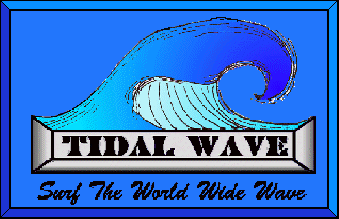
Tidal Wave Communications was my first company. Before the later platforms, teams, and ventures, there was this early piece of the web. I want to keep it here as part of the story.
The original website survives in the Internet Archive. Its footer still credits me as “Web Author: Allen T. Hurff II.” The breaking-wave logo, tiled water, and promise to “Surf The World Wide Wave” belong to that moment. This is where building a company started for me.
A computer under the Christmas tree
I was born in Manassas, Virginia, and was living in North Carolina by the time I was five. I was ten when I got an IBM PCjr for Christmas in 1984. That machine is where I trace the beginning. A friend later had a modem, a second phone line, and a bulletin-board system. I was jealous. The interest in computers was already turning into an interest in what people could do with them together.
I left for Radford University in August 1992 and studied communications there until December 1994, when I returned to Manassas. By twenty, I was involved in a dial-up startup. Computers and communications were already becoming parts of the same story.
Craft is part of the story
Software is not my only point of reference. Elbert Hubbard and Roycroft, Dard Hunter, Dieter Rams, Ray and Charles Eames, vintage books, and typeset printing have all been part of my interests for years. They even appear together in my old LA Makerspace biography.
My involvement with LA Makerspace belongs alongside the engineering work, not outside it. The overlap between technology, design, and making has been a recurring part of my life. HurffHaus is a place to bring those interests into the same room: the working history, the projects, the reading, and the things still taking shape.
The LA Makerspace biographyFor the record
The conventional version.
The narrative above follows the thread. Here are the roles and dates behind it.
Open the career record
- Apr 2023–present
Basis Worldwide
Senior Solutions Architect
- Jul 2020–present
HurffHaus
Founder
- Jul 2019–Jun 2020
Johnson Controls
Senior Engineer, DevOps
- Dec 2018–Mar 2019
Imbellus
DevOps Lead
- Jun–Sep 2018
Eliassen Group · AT&T–DIRECTV
SAFe 4.5 DevSecOps Solutions Architect
- May 2016–Nov 2017
Datapipe
Senior Development Manager
- May 2014–Jul 2016
Zuma Ventures
Co-Founder & CTO
- Jan 2012–May 2014
Science, Inc.
EIR & Solutions Architect
- Mar 2010–Dec 2011
Pose
Co-Founder & CTO
- Mar 2005–Jul 2009
MySpace
Executive Vice President of Engineering
- Sep 2001–Jan 2003
Experian Consumer Direct
Senior Engineer
- Jan 1998–Jul 2000
AltaVista
Manager
OpenSocial Foundation
Chairman & Board Member · November 2008–July 2009
Selected speaking
Google I/O 2008 keynote, “Client, Connectivity, and the Cloud”
Education
Radford University · Communications coursework, 1992–1994
The next chapter is still being made.
What the House is for